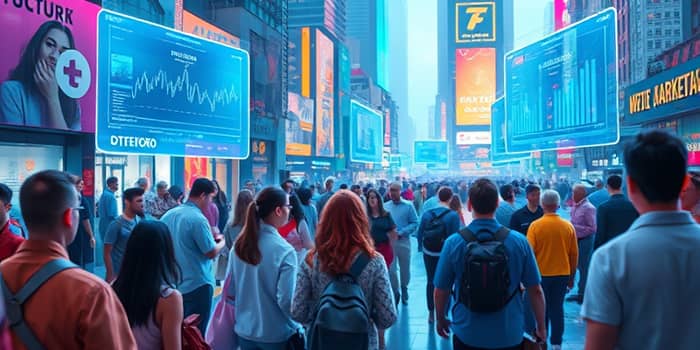
In the wake of a global crisis, digital markets have emerged stronger, reshaping commerce, communication, and culture. This article delves into the forces driving this transformation and offers insights into the future of a connected world.
Unprecedented Statistical Growth
The past five years have witnessed a radical shift in advertising and user engagement. By 2025, digital channels capture over 72 percent of global ad spend, with online investments climbing past US$790 billion. This marks a clear departure from 2018, when digital held less than half of worldwide ad budgets.
- 30% jump in digital ad spend from 2020 to 2021
- 10.3% year-on-year increase (+$74 billion) between 2023 and 2024
- Projected CAGR of 9% for digital marketing (2020–2026)
- Digital display ads growing at a 15.5% CAGR
Equally striking is the expansion of the global internet population. As of April 2025, 5.64 billion people—68.7% of humanity—are online, more than twice the number offline. Mobile devices drive this trend, accounting for 95.9% of user access and 62% of web traffic.
Data creation has exploded alongside connectivity. Global data volumes are forecast to reach 149 zettabytes in 2024 and surge to 394 zettabytes by 2028, fueled by remote work, virtual learning, and digital entertainment.
Drivers of Digital Transformation
The COVID-19 pandemic acted as a catalyst for rapid digital transformation across industries. Telemedicine, virtual classrooms, e-commerce, and remote work became mainstream almost overnight. Organizations that had previously resisted online models embraced them out of necessity, and many continue these practices for their efficiency and reach.
Social media and video platforms further accelerated the shift. Hyperscale services are redefining content consumption, with short-form video and live streaming engaging audiences in real time. This environment fosters immersive virtual collaboration tools and drives innovation in both entertainment and enterprise sectors.
Implications for Business and Society
As digital channels dominate marketing strategies, businesses of all sizes leverage content-driven marketing strategies for growth. Self-service advertising tools on social platforms enable small and medium enterprises to compete with larger brands, democratizing access to global audiences.
- Identifying and nurturing online communities
- Using data analytics to refine customer targeting
- Balancing automation with personalized outreach
- Investing in secure, scalable ad platforms
At the societal level, digital adoption has enhanced access to education and healthcare. However, it also raises questions about privacy, surveillance, and equitable access. Policymakers must navigate these issues to ensure that technological gains benefit all citizens.
Bridging the Digital Divide
Despite overwhelming growth, roughly 2.57 billion people remain offline, concentrated in parts of Africa and Southern Asia. Closing this gap requires investment in infrastructure, affordable devices, and digital literacy programs. High-quality connectivity is as critical as mere access.
- Expanding broadband networks to rural areas
- Subsidizing mobile devices for low-income households
- Offering community-based training in digital skills
- Ensuring content relevance in local languages
Addressing the digital divide also means combating misinformation and fostering online resilience. Communities must be equipped to engage responsibly, preventing the rise of insular or extremist digital spaces.
Looking Ahead: Opportunities and Innovations
The future of digital markets lies in emerging technologies and forward-thinking policies. Blockchain-based applications promise transparency in online education and healthcare, while artificial intelligence enhances personalization and decision-making. Businesses and governments must adopt cutting-edge secure technologies for tomorrow to protect data and build trust.
Privacy concerns will drive the development of new frameworks, balancing individual rights with collective benefits. As remote work persists, companies will refine hybrid models, optimizing productivity and employee well-being through double-digit year-on-year increase across sectors in tools and processes.
Looking beyond 2025, digital markets are poised to become more adaptive and inclusive than ever, harnessing the power of innovation to connect people, empower businesses, and enrich lives around the globe.
References
- https://www.wordstream.com/blog/ws/2022/04/19/digital-marketing-statistics
- https://www2.deloitte.com/us/en/insights/industry/technology/digital-media-trends-consumption-habits-survey/2025.html
- https://datareportal.com/global-digital-overview
- https://www.responsify.com/digital-marketing-statistics
- https://datareportal.com/reports/digital-2025-global-overview-report
- https://pmc.ncbi.nlm.nih.gov/articles/PMC7280123/
- https://www.statista.com/statistics/871513/worldwide-data-created/
- https://www.pewresearch.org/internet/2021/02/18/experts-say-the-new-normal-in-2025-will-be-far-more-tech-driven-presenting-more-big-challenges/