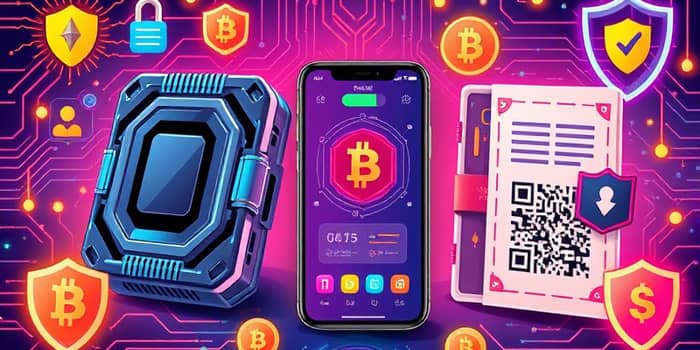
As digital assets increasingly shape our financial future, understanding how to protect them becomes an emotional journey and a technical necessity. In 2025, with billions invested worldwide, security is not just a feature—it’s a lifeline.
Understanding Cryptocurrency Wallets in 2025
Every crypto enthusiast faces a pivotal question: how do you store and protect your digital wealth? Wallets come in five major forms, each offering unique trade-offs between convenience and safety.
- Software Wallets (Hot wallets)—Desktop, mobile, and web-based apps always connected online.
- Hardware Wallets (Cold wallets)—Physical devices like Ledger and Trezor storing keys offline.
- Physical/Paper Wallets—Printed QR codes and keys, true cold storage without electronics.
- Custodial Wallets—Exchanges manage your private keys, prioritizing ease of use.
- Non-custodial Wallets—You alone hold the private keys, owning full responsibility.
Core Security Features and Vulnerabilities
At the heart of every wallet is the private key—your ultimate access to funds. If exposed, that key becomes a gateway for attackers.
Key security factors include:
- Private key protection at the core, ensuring keys are encrypted or stored offline.
- Password strength—unique, complex passphrases managed in secure vaults.
- Multi-factor authentication across platforms, adding layers beyond mere passwords.
- Seed phrase integrity—guarding the 12 or 24 words that enable recovery.
- Routine backups—offsite or in safes to guard against device failures.
- Device security—keeping endpoints free from malware and exploits.
Security Comparison Across Wallet Types
Evaluating security means weighing threats against strengths. The following table offers a clear comparison for users deciding on their ideal solution.
Top Wallets and Their Security Ratings
2025 leaders blend innovation with proven safety. Hardware champions include Ledger Nano X and Trezor Model T, offering robust chip-level encryption and firmware validation. Software frontrunners like Exodus pair user-friendly interfaces with occasional integration of hardware devices for hybrid protection. Custodial giants—Coinbase and Kraken—maintain advanced security operations centers, though they inherently carry counterparty risk.
Implementing Best Practices for Maximum Security
Beyond choosing a wallet, how you manage it determines your ultimate safety.
- Store significant funds in cold wallets and keep multiple, encrypted offline backups.
- Always enable MFA on wallets and exchange accounts.
- Update wallet software and firmware promptly to patch vulnerabilities.
- Use password managers and unique strong passphrases for every wallet.
- Verify wallet downloads and firmware only from official sources.
- Never store private keys or seed phrases in cloud drives or digital notes.
Incident Trends and the Evolving Threat Landscape
High-profile breaches remind us that no system is invulnerable. In 2023–2024, supply chain attacks targeted hardware wallet shipments, prompting direct-vendor purchases. Malware-disguised wallet apps continue proliferating on mobile marketplaces, preying on inattentive users.
Meanwhile, exchange hacks still lead headlines, with custodial wallet losses reaching hundreds of millions annually. These incidents fuel a growing industry commitment to transparent audits and decentralized security measures.
Balancing Security and Usability
The desire for seamless transactions often conflicts with stringent safeguards. Hardware wallets, while offering unmatched offline protection, require manual setup and physical access, making them less ideal for frequent trades. Conversely, hot wallets excel in agility but are vulnerable to endpoint exploits if device security is lacking.
Regulatory Standards and the Road Ahead
Global frameworks now emphasize secure key generation, robust access controls, and user privilege management. Exchanges face heightened KYC/AML scrutiny, pushing custodial providers to fortify internal protocols. Meanwhile, standards bodies advocate for open-source transparency, enabling community-led audits and fostering trust.
Emerging Innovations Shaping Future Wallets
Tomorrow’s wallets will blend convenience with advanced security architectures.
- Biometric authentication integrated into hardware devices.
- Multi-party computation and threshold signatures distributing control.
- Decentralized identity frameworks tying wallets to verifiable credentials.
- On-chain governance enabling dynamic security parameter updates.
Conclusion
In an era where digital finance is woven into the fabric of daily life, protecting your cryptocurrency demands vigilance, knowledge, and the right toolkit. By embracing hardware-based cold storage, rigorous backup practices, and multi-layered authentication, you take control of your financial destiny. Stay informed, remain cautious of evolving threats, and choose strategies that align with your risk tolerance and usage patterns. Only then can you navigate the crypto landscape with confidence, securing both your assets and your peace of mind.
References
- https://www.investopedia.com/the-best-crypto-software-wallets-11699325
- https://materialbitcoin.com/en/blog/best-crypto-physical-wallets/
- https://trezor.io/compare
- https://www.cryptoeq.io/articles/wallets
- https://coinbureau.com/analysis/most-secure-crypto-wallets/
- https://www.arkoselabs.com/explained/guide-to-cryptocurrency-security/
- https://www.investopedia.com/terms/b/bitcoin-wallet.asp
- https://csteachers.org/crypto-wallet-security-explained-a-practical-guide-for-all-learners/